
Agricultural buildings
Farm buildings, measured the same way.
Small farms and agricultural operations across Central Bohemia often run commercial-scale electrical loads: cold storage, milking parlours, grain drying, workshop machinery, irrigation pumps. These fall within the scope of a small commercial building, and the same metering and thermal imaging approach applies.
Where farm buildings differ from offices
An office building tends to have many small, distributed circuits: lighting zones, workstations, a kitchenette. A farm building usually has the opposite profile: a small number of large loads, a refrigeration compressor, a ventilation fan bank, a water heater for a milking parlour, that dominate the total draw. The metering plan is adjusted accordingly, prioritising the largest motors and compressors first rather than spreading sensors evenly across every breaker.
Seasonal variation is also sharper. A grain drying installation might run at near-continuous load for a few weeks at harvest and sit idle the rest of the year, which changes how a monthly report should be read during that period.

Livestock buildings and thermal imaging
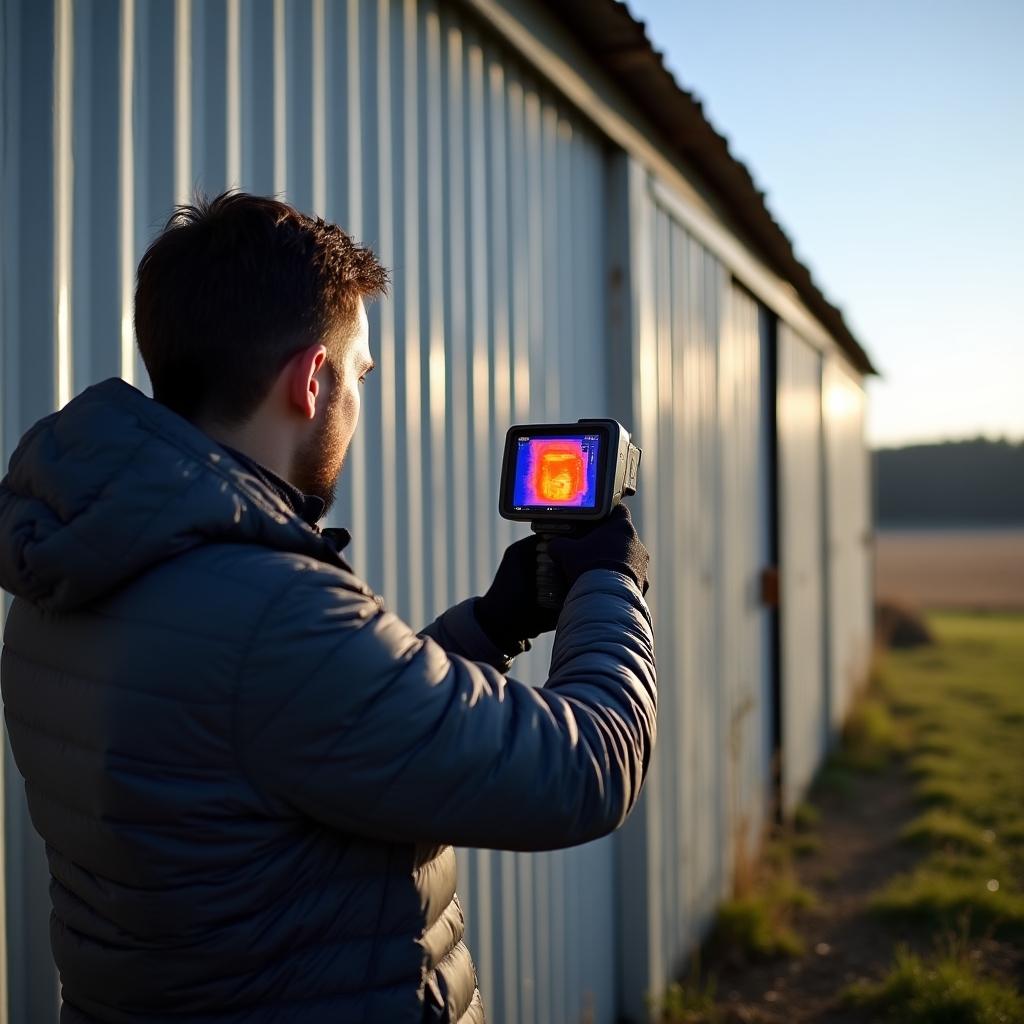
Barns and poultry houses depend on a stable internal environment maintained through mechanical ventilation and, in colder months, supplementary heating. A thermal imaging survey maps heat loss around ventilation inlets, roof insulation, and wall junctions, information relevant both to the energy cost of maintaining that environment and to how consistently it's actually being maintained. We document what the camera shows; how it's addressed structurally is a decision for the building owner and their contractor.
Cold storage and refrigeration circuits
Cold rooms and refrigerated storage typically run on a small number of dedicated circuits, which makes them straightforward to isolate with circuit-level metering. We track compressor duty cycles, the proportion of time a unit spends actively running, and pair that with thermal imaging around door seals and thresholds, since a poorly sealed cold room door forces the compressor to work harder than the refrigeration load alone would require.
Seasonal considerations for agricultural sites
Because farm loads shift sharply between harvest-season drying or processing and winter heating of animal housing, we generally recommend a monitoring period long enough to capture at least one full seasonal cycle before drawing conclusions about a building's overall consumption pattern. A single month of data on a farm can be misleading in either direction, depending on what time of year it happens to cover.